Basic C++ STL Library Utilities
03 Oct 2021Vectors
Include:
#include<vector>
Initialize/Declare:
vector<int> A={1, 2, 3, 4};
vector<int> B(82, 0);	// Vector of size 80, initialized with 0
Pushing a value at the end:
A.push_back(100); // A = {1, 2, 3, 4, 100}
SORT:
#include<algorithm>
sort(A.begin(), A.end());  // O(Nlog(N))
SEARCH:
#include<algorithm>
binary_search(A.begin(), A.end(), 3);  // O(log(N)); RETRUNS: BOOLEAN
Now lets push in some more values:
A.push_back(100);
A.push_back(100);
A.push_back(100);
A.push_back(120)
Now A={1, 2, 3, 4, 100, 100, 100, 100, 120}
Finding 1st element >= 100:
vector<int>::iterator it = lower_bound(A.begin(), A.end(), 100); // O(N) ; RETURNS mem value of 1st 100
Finding 1st element > 100:
vector<int>::iterator it = upper_bound(A.begin(), A.end(), 100); // O(N) ; RETURNS mem value of 120
Therefore to find the number of occurrences of a value, we can first sort a vector, then find the difference between the values returned by lower_bound and upper_bound function with the value as input.
Set
-
ALWAYS Sorted
-
NO Duplicates
-
O(N)
Include:
#include<set>
Initialize/Declare:
set<int> S {1, 2, 3, 4, 100, 500, 1000};
Pushing a value at the end:
S.insert(100); // S {1, 2, 3, 4, 100}
SEARCH:
auto it = S.find(2);  // O(log(N)); RETRUNS: Iterator

if (it == S.end()){ cout << "This happens when Not Found in Set!" }
Finding 1st element >= 100:
set<int>::iterator it = S.lower_bound(100); // O(N) ; RETURNS mem value of 100
Finding 1st element > 100:
set<int>::iterator it = S.upper_bound(1000); // O(N) ; RETURNS mem value of 1000
Pair
Include:
include<pair>
Initialize/Declare:
pair<int, int> P1;
P1.insert({1, 5});

pair<int, char> P2;
P1.insert({1, 'a'});
Accessing pair elements:
P1.first = 1;
P1.second = 5;
Mixing Sets and Pairs:
set<pair<int, int>> S; // Set of pairs
Comparison:
Pair {a, b} is smaller than Pair {c, d} iff (a<b) OR (a==b && c<d)
Map
- Like python dictionary
- Stores (key, value) pairs
- No duplicate keys allowed
- Implemented using Binary Search Tree (BST)
- O(log N)
Include:
#include<map>
Initialize/Declare:
map<int, int> A;

A[1]   = -1;
A[40]  = 2;
A[-20] = 200;

map<char, int> A;

A['a']   = -1;
A['b']  = 2;
A['c'] = 200;
Using Map, finding the number of instances of each character in a string:
map<char, int> M;
string x="jeet majumdar";

for (char c: x){
    M[c]++;
}
Unordered Map:
- Implemented using Hashing functions
- Essentially an array is used at the end for bookeeping
- Fast than Maps
- O(1)
Include:
include<unordered_map>
Usage is similar to Map
Read: https://www.modernescpp.com/index.php/more-special-friends-with-std-map-and-std-unordered-map
Ref: https://www.modernescpp.com/index.php/more-special-friends-with-std-map-and-std-unordered-map
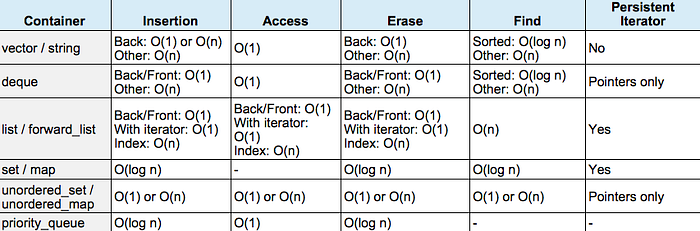
Ref: Table from: “ STL Container Performance ”